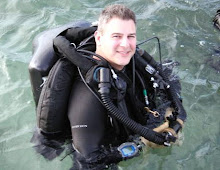
Monday, May 05, 2008

Thailand April 2008


Went to Thailand. Had some fun, did some dives.

Tuesday, April 15, 2008

Resort Ice Diving Winter 2008

Ice Pogo
video

Fat times on thin ice in Rockport...

Florida Cave Diving January 2008

Wherein we laughed, we cried, we drove all night, and I took a pretty substantial CO2 hit. More later...

Monday, December 10, 2007

Norness Again and Again

For a while now I've been meaning to do a Norness update. I just got back the porthole all cleaned and mounted, so now seems a good time. Visible in the closeup is the pattern left where the anemones had attached, which remained even after soaking in acid.


I was able to get back to the Norness two more times this year. The first time was on July 31st. The Sea Turtle steamed out at 4am, with Elliot Bertoni, Adam Altman, Tim Dwyer, John Bricker, Andy Koppinger, and Captain Chuck. Andy and John dropped down to tie us in, and I followed immediately thereafter. After the last trip I was excited to see more of the ship, and to get a better mental picture of the wreck. The tie in was right at the cut, and I could see now that I had the whole orientation bass-ackwards last time - it's on its starboard side, not port, and what I had thought was the trashed remains of the gun tub were just run-of-the-mill trashed remains. I didn't waste any time in dropping to the bottom and heading aft through the debris field, but between the low light, plus watching for entanglements, I came up empty-handed. At the prop I turned, and was back at the line showing an hour of deco. I wanted more though, and since I don't mind a long hang I continued to explore. The forward superstructure is open and inviting, so in I went for a quick dig in the debris. The floor is finished in red and white square tiles, nicely marked on the back with a date. A set of those went into my goody bag, as well as a brass fan blade. After 45 minutes I began my ascent. I knew I was in for a cold deep spell when my 150' stop was already 2 minutes, and in fact it took an hour to reach the welcome warmth of 70'. Total run time was 3.5 hours, including some extra time I put on for safety's sake.

September 5th I went again with the Sea Turtle. Onboard was Jonathan Iseson, Elliot Bertoni, Ted McCoy and Captain Chuck. The mooring we had left last time was nowhere to be seen, so Ted and I splashed together to go set the hook. Like a teaser, halfway down we could see it, with the line fouled over a lifeboat davit. As luck would have it the grapnel had dropped to the sand. Ted climbed up the wreck using it as an ice axe while I belayed with the chain, and at ten minutes we were tied in. I immediately dropped to the bottom to snoop about the debris field. I soon came across a lovely porthole, glass intact, in a bit of steel plate. I was able to easily move it, so I hooked up a lift bag and started filling. And filling. Aannddd filling. I jostled it a bit, in case the mud was holding it down. Still it wouldn't move. Bailout is for survival not brass, so after putting 500 psi I tried another tack: the buddy bag, with its own small inflation bottle. It was with high expectations that I tied it in and cracked the valve. FSSsss. Talk about disappointment! It was good for one mouse-size asthmatic wheeze, barely enough to hold the bag up. I was about out of tricks, but the thought occurred to me that perhaps, if I moved it out from the overhanging superstructure, I could then pull it up enough for the bag to inflate. No sooner had I started hauling it over when I felt a tug, and looked down to see my bailout reg entangled in the line. Ever wonder what its like to get dragged to the surface from 285'? Me neither, or rather I have, and its the stuff of nightmares. I was disappointed to leave my bags, much less the porthole, but I had NO hesitation walking away from this situation. None whatsoever. I got back to the tie in showing an hour and twenty minutes deco, which was still reasonable to me so I spent another 15 minutes cruising the wreck. I visited the gun tub, the real one this time, to check out the 5" gun. I had gotten some good beta to look for the letters, so I took a pass at the stern. Next to the bell I think those would be just the most amazing artifact, but sadly it appears the Norness didn't have any. Finally I took a few minutes to work on a porthole with a crow bar I had brought. Fat Max might have been up for it but I wasn't: they still seem pretty tight into the superstructure, and besides after hauling the chain, swimming the the length of the wreck twice, and working on that porthole, did I really need to exert myself more? I left the tool next to the portholes on the forward superstructure, so anyone who goes down there is welcome to use it, just leave it where you found it. At 50 minutes I began my ascent, for a 3 hour hang. On the way up I saw cave line paralleling the anchor line, with a lift bag on top. I was hoping to see something juicy dangling below it, but it too was all about survival not booty. It seems Jonathan had also dropped down to search the bottom. It's like a spider's web of fishing line down there, and before he knew it he was a fly caught in it. After 5 minutes which must have seemed like an eternity he finally cut himself free, but at that point there wasn't enough gas left in his tanks to go looking for the anchor line. Again showing the value of training, experience and skills he bagged off, jumped over to the anchor line when he saw it nearby, and finished his dive safely.

We didn't take anything from the Norness that day, but more importantly it didn't take anything from us, at least nothing that matters. It's a bit of black humor that after every dive I text message my wife "Cheated Death Again." This day in particular it rang true.

Monday, November 12, 2007

Pinta November 11 2007

It is getting chilly out, no two ways about it. During the drive down and ride out I couldn't wait to get into the water to warm up. With the seas kicking we decided to stay inshore, and parked above the Pinta right off the Atlantic Highlands. On May 8, 1963 the Pinta had the misfortune (well, the incompetence, really) to collide with the City of Perth. Clear skies, moderate seas, 14 miles of visibility, but still they hit each other, with the Pinta sinking in 48 minutes. There were no fatalities, so at least they abandoned ship in good order. It was my first time on this wreck. It has been very quickly deteriorating in recent years, so I was glad to see it sooner rather than later. The Independence had a full charter, a nice mix of newcomers with the regulars. Just goes to show how avid people are to dive around here, even late in the season.
The Pinta was carrying a load of pecky cyprus, which becomes obvious as soon as you descend onto the wreck. Board lengths are scattered every which way, all more so now that it is falling apart. Dave O had us tied into the stern, so I started by spending a few minutes working my way into the engine compartment. Viz was pretty punk, 8' or so, with an intermittent surge that was occasionally impressive. Over the course of nearly two hours I swam stem to stern, out into the sand, and wiggled into as many holes as I could fit into. One of the forward holds teased me terribly. The decking is just starting to really go, and through the gaps I could see undisturbed silt. I even considered, then rejected, ascending to fetch Fat Max the wrecking bar from above. After 90 minutes I finally found a keeper bug, and that one was wedged deep inside. Catching it involved completely silting out the hold and coating myself in rust, but I got it, puny one-clawed thing that it was. Max depth was only 89 feet, my shallowest in a long time. I had no complaints though, only having 20 minutes of deco was a real treat. The only hiccup, so to speak, was a brief but bizarre reverse block in the last 10 feet. I had made a choucroute for a little dinner party the night before, an assortment of sausage and smoked meat buried in sauerkraut. Note to self: go easy on the kraut the night before diving!
Not much more to tell, just a nice, moderately bumpy day on the ocean. Getting back at 2pm was a treat, so a few of us went to Europa for lunch. Good food, decent prices, and despite the fancy decor they didn't turn their noses up at a bunch of fleece-clad divers with salt-spiked hair.

Wednesday, November 07, 2007

U-869 October 30 2007

We've all heard the cliche about the perfect storm, where several factors come together to make a righteous mess. Tuesday we had the polar opposite, just a perfect fall day with plenty of sun, warm water and calm seas. Just goes to prove that even in late October Mother Nature grants favors. A crew of us headed out to the U-869 onboard the Independence, for a one-and-done day. Brandon McWilliams and Bill Trent did a quick and able tie-in, and at 11:30 my buddy and splashed. Even at this late date the water was 63F down to about 90', which was just lovely. My lpi displeased me greatly by bleeding air into the wing, but early on I caught onto what it was doing and unplugged it. We penetrated the stern section, and spent our time probing about, then a few more minutes swimming forward outside the hull. At 40 minutes he headed up, but I wasn't ready to go yet. I had never seen the screws, so I returned to the stern and dropped down. They were indeed splendid, as was the 6# bug I pulled from a box next to them, plus another 2#er lurking nearby. When I was here last month I had seen a 3# hopelessly entangled in fishing line. I really hate that, and felt bad that I didn't have the time to cut him free. To my surprise we met again, and in no time I had saved him (and me) from a cruel death by starvation. At 57 minutes I left the wreck for a longish, 2h15m deco, which was quite comfortable once I cleared 80'. I wasn't the only one to bag up, as Brandon and Bill grabbed another 5 bugs, including a very pretty 8.5# one. Brandon was even so kind as to donate a 3#er to the Infante Lobster Bisque Fund - watch that tail kitty!

Eau Canada October 5-7 2007

Fall has become my favorite time of year to dive the St. Lawrence. The water is still warm, most of the tourists are gone, and the visibility is superb. Carl Bayer, John Bayer, Sunny Longordo and I made the trek up, where we later rendezvoused with two divers they had met on the Empress of Ireland. David Hutchinson who shall be known as Gizmo and Michael Woods aka Captain Disaster are Canadian but not quite local, as I believe their drive in was longer than ours. Good divers and good company, it was a real pleasure to spend some time with them.

The first day started with a bit of a bang. I've dived the Lillie Parsons before, and I've dived the King, but this was the first time I did one then drifted onto the other. The Lillie is an old wooden coal schooner lying turtled in about 50 feet. Its a fun dive to swim through, especially as the light penetrating through the cracks is quite pretty. 10 minutes was about enough to sample her charms, then Carl and I set off for the King. A drillboat, it sank in an explosion in 1930, and lies in the 150' range. The drift was a long one, roughly 40 minutes, with the current alternately racing and slacking based on the topography. It was a nice way to make two been-there done-that wrecks much more fun. Another diver from our boat had stayed on the Lillie, but was mighty freaked out when a freighter went by and he felt himself being pulled up! That would weird me out too. For dive two we went to the Daryaw. The engine room is a fun place to go wiggle through, but mostly I just enjoyed letting the current take me for a fast ride over the keel.

The next day David and Michael arrived, and were beside themselves with delight at receiving secret New Jersey diver contraband: milk crates. You have never seen plastic boxes give such joy. We went out on Wayne Green's newest boat, the River Diver. It is spacious, which was good since we had a large group. Unfortunately John suffered from sensory deprivation on his rebreather, which we were unable to fix, and thus had to sit the dives out. The America has some opportunities for penetration, but the best part is when freighters come over. From 75' down you can really feel the throbbing from the engine in the middle of your chest. For the afternoon we headed over to the Keystorm, along with every other diver in Canada it seemed. Bubbles bubbles everywhere. There was also an impromptu game of soccer using Sunny's head as the ball. Well, really there was just one other player, but she kept kicking her repeatedly. I guess Sunny was just so happy to be back diving that it didn't hurt her buzz, otherwise Pele risked being strung up by the tail like a trophy.

That afternoon was my real reason for coming here, to dive on the Oconta. A beautiful wooden schooner, its remains lie between roughly 150' and 185'. Oddly enough I was the only one on the boat who has been to it before, so I gave everyone a briefing and was promptly voted First to Go In. The current was fairly ripping, and just swimming the 30' or so from the boat to the beacon rather kicked my ass. I've dived this site with a line running down to it, and I've dived it without. Unfortunately today the line was gone, which made me question doing the dive at all. I decided to go for it though, the sun had set so it would be a lovely night dive, and I was reasonably comfortable I could find it. There is room to stand by the beacon, so after working out a dive plan with the guys on the boat (primarily, Who's reel am I taking if you guys don't recover mine?), Carl and I headed down. It was my good fortune that the old line had parted at the top, so when we got down to 150' it was floating out horizontally behind the Oconta. It was a relief to get tied in, as I knew in about ten minutes the boatful of guys were going to come barreling down my reel. The last thing I wanted was to have a pile of divers staring at me at 170', and only be able to shrug my shoulders. Two divers were using scooters, and no sooner had we tied in than I heard the whir of their props. I was able to point the two anchors out to Carl, which have led some folks to believe there are two wrecks there (I'm pretty firmly in the one-wreck camp.) Terry Irvine was shooting video, so while penetrating I made sure to shine my light through the cracks in the hull for effect. We all wound up leaving the wreck at about the same time, clinging to the sheer wall for purchase in the flow. At 20 feet my manual O2 injector stuck open, which made things rather more interesting. Fortunately I was able to unplug it quickly before it took me up, but it sure did me get my heart moving. We also learned that Carl desperately needs a constant PO2 computer. Both of my computers had cleared by 15 minutes, and we were the last ones in the water, when I checked how much he had left. "Twenty minutes!!!" I almost lost my dsv.

I was pumped up from the dive, and hadn't even crossed over the transom when I burst out with "Was that great or what?" Stony silence. "Um, you guys didn't like it?" More silence, then a staccatto "No. Too much current" from Giz, with another asking "Is that what diving in New Jersey is like?" I got a real kick out of that.

Sunday's dive was a one-and-done on the Jodrey bow. Our boat was moored directly over the line running down to the bow, making navigation a snap. Michael had skipped the dive, so I buddied up with David. Despite several dives here I found myself impressed all over again with the sheer size of it. Wayne Green had told me once about two divers that he has brought here every Sunday, season after season, and I can appreciate why. There are just so many places to explore. After dipping into a cargo hold and doing a few swim-throughs we spent our time staying higher on the wreck. There's something just so comforting on a dive to see the strobe blinking away on the line. At deck level of the forward superstructure is an area oddly free from zebra mussels. Despite 33 years underwater it was nearly devoid of silt due to the current, and was intact right down to the fiberglass insulation peeking out of the ceiling. The bridge too has decayed very little, such that it is possible to still read the sticky tape on the instruments calling out "Calibrated to Statute."

As happens so often when I dive, before I'd finished deco I was already looking forward to the next time...

Tuesday, September 25, 2007

USS S-5 and the RP Resor September 22-23 2007

I've wanted to dive the S-5 ever since I first read its history. Commissioned in 1920, the sub had just completed trials, and was on its first assignment. While performing a test dive the main induction valve was left open, and then when belatedly closed it jammed. The backup was to close the valves to the individual compartments, but the forward torpedo room valve was stuck. The crew scrambled from the bow and sealed it off, while the sub crashed into the sea bed in 180 of water. With all those tons of water, it was impossible to float the sub. An attempt was made to pump out the torpedo room, but the bilge pump failed. The crew were trapped, with limited air, no escape hatch, no escape lungs, and no one looking for them. The only thing at their disposal was their wits. The captain knew the sub was 231' long, and in 180' of water. In theory if they blew the aft ballast tanks and fuel tanks they might be able to lift the stern to the surface enough to get a hatch out of the water. However, in the process water would run over the batteries and cause toxic chlorine gas, so the trick was to do it quickly and then slam the hatch and shut it, keeping the toxic fumes isolated. With their fingers crossed they blew the tanks, and what was horizontal now became vertical, cascading down through the sub. They nearly lost a man in the battery room, but were able to pull him out and slam the hatch. By hammering on the hull they discerned that 17 of the stern was sticking out of the water, not enough to get to the hatch but better than nothing. The next task was to drill air holes, for which they were woefully underequipped. By using a power drill (and semi-electrocuting themselves in the process) they were able, over the course of 36 hours, to make a 3" hole in the 3/4" thick steel. In what must have been heartbreaking, they watched a ship sail past them without noticing. The next day the wooden steamship SS Alanthus nearly did the same, but then decided to investigate this odd-looking buoy. The conversation that ensued is legendary:

"What ship?" asked the captain with his face near the hole.
"S-5," came the reply.
"What nationality?" he asked.
"American," came the reply.
"Where bound?" he asked.
"TO HELL BY COMPASS!" came the reply.

Amazingly, there were no fatalities. The Navy made several attempts to salvage it, finally giving up the effort in 1921.

This was my first time on the Pirate King, out of Cape May, and I must say it was mighty comfy. I slept on the boat the night before, so the 4am departure didn't bother me at all - in fact I don't think I got out of my bunk until after 8. The sky was a beautiful blue, with nary a zephyr. Some of the guys I knew, some not, but its always easy talking to divers, and we chatted the ride away. The captain gave a hue and a cry, and we all looked to the side to see a pod of dolphins leaping out of the water as they approached the boat.
I ran to the bow with several others, but we were surprised to see that they just disappeared. It was only after several minutes that someone looked down. The entire pod of 11 dolphin were directly below us, surfing the bow wave without scarcely moving their fins. It was intense. I've been lucky enough to see them underwater several times, but they always flash by quickly. Here they were, 5 feet below us and seemingly stationary. Every once in a while one would rise for a breath, and rolling on its side look up at us. They stayed with us for nearly 15 minutes, until the captain cut the throttle back and their free ride was over. Mark Ostojich shot some video that he's let me post:

video

Shortly thereafter a whale swam by us a ways off the starboard side. No pictures unfortunately, no one had a lens big enough to do it justice. My God what a massive creature.

I splashed to minimal current. The S-5 is in surprisingly good condition, and lies upright in a small washout at 160'. Several hatches were open, offering easy opportunities for penetration. I poked about, and swam around it twice before I could no longer resist. Everywhere I looked were scallops. Everywhere. I've never seen so many in my life! It took me two minutes to stuff two dozen into one bag, and only a little longer to stick 7 dozen into another. Cram I should say, I kept trying to put so many in that I feared they'd cut the bag and all spill out. I had planned on one long dive, but that changed quickly when I realized I needed to go empty my bags. So, at 53 minutes I headed up, with well under an hour of deco. At 80' conditions became tropical, 73 degrees and well over a 100' of visibility. I spent my time rattling a chain and hoping that that plus the steady rain of chicken bones from above would get some attention. I'm not sure if it was causative, but shortly thereafter a porbeagle shark swam by me several times.

Unfortunately dive 2 was not to be, as in the interests of safety we headed in. It seems a diver had had a problem, which led to another problem, which led to a feet-first ascent from 60' with plenty of deco left. He must have been buying scuba indulgences as he was fortunate enough not to have any symptoms. Not how I wanted it, but I now had a slot on the Independence for Sunday's Resor trip. I was able to sleep onboard the boat, which gave me the opportunity to load up early, and observe Marina culture up close. They say familiarity breeds contempt, but in this case it didn't; it was more like rage. Up and down the dock lawnchairs were setup for an impromptu cocktail party so that they were facing each other knee to knee. D'ya think you can move your loud drunken good-god-that's-more-than-I-wanted-to-see fat ass aside long enough for me to move down the dock? Apparently not. Even the yippy dogs lacked the sense to move out of the way. It did make the 5am load-in very sweet though, I reveled in every decibel we made.

The boat was full but not overly so. When we arrived the Gypsy Blood was there picking up their mate who had gotten blown off tying in. Captain Dan put the shot right next to the stern, and in minutes Dave O had us tied in. The scalloping hasn't much recovered from when I took 7 dozen off of here last month, though I was able to scrape together another dozen, as well as one-offs from the other divers. The Resor has some relief at the bow and stern (which was reinforced for what, at the time, was a state of the art propulsion system.) After a quick tour of the stern I headed forward, tying off before entering the debris field. In short order I had made it to the bow, picking up two lobster along the way, before doubling back to play in the debris field. Its quite a tangle of pipes and plates, but I think after another dive or two I should have it laid out sufficiently in mind to skip the reel.

This dive was a bit of a trial run for my Hammerhead. I've been kicking around the idea of going to heliox, and had heard from a friend that the Hammerhead will run it. This has some value to me, since if I tell the Explorer I'm diving 10/90, as opposed to 10/50, it roughly quadruples the deco time. Unfortunately it was the same with the Hammerhead. I left the bottom at 80 minutes, with both explorers showing 40 minutes (10/50), and the Hammerhead calling for over two hours.

I had seen a decent size lobster under some plates, but hadn't wanted to spend the time getting him out (I'm also a bit lobstered out, truth to tell.) When I mentioned it Renee Bachar's ears perked up, so I told her where to find it, and loaned her my tickle stick to aid in the pursuit. You know the line about "no good deed goes unpunished"? All I saw on dive two were big bugs, 4#er after 4#er, and all just out of reach. I did nab a nice 3# one, but it was a she so I released her. Not long after I was trying to twist around a plate to grab another when I felt a cold, uncomfortable sensation: water seeping through the 3/8" hole I had just sliced in my drysuit. I wasn't looking at much deco, but I still wasted no time grabbing my reel and heading the 300' back to the tie, in my haste forgetting my (empty) goody bag. For this dive it was an inconvenience, but I couldn't help thinking how on a longer dive in colder water I'd be in some serious trouble.

It seemed to be a trip for minor mishaps, between the Hammerhead not performing to expectations, the bugs staying beyond arm's length, the cut drysuit, and the lost bag. Just to pile it on, as soon as I climbed aboard my arms started feeling sore. I had done extra deco on both dives, but the bouncy hang on dive one had strained my arms. The deltoids are a hotspot for me, so once my gear was secured I had me a bit of a lie-down on O2. At 15 minutes I felt better, at 20 I was fine. Somewhere in there I fell asleep, which was odd to wake up with a reg in my mouth. Also a little uncomfortable, as my suit was now good and flooded, so that every time I straightened my legs out I got a little internal tsunami.

I really do need to start bringing a bottle of soy sauce and a lemon for scallop sushi. Maybe Dan will let me plug in a rice cooker? 10 dozen scallops for the weekend made the family very happy.

Monday, September 10, 2007

The Lillian September 9 2007

The freighter Lillian met her end in a fog bank, on February 26, 1939. She and the German freighter Wiegand only saw each other when they were a few hundred yards apart. Both ships attempted evasive manuevers, but despite their efforts they collided with such force that the Lillian's bow shoved the Wiegand's portside plating through the superstructure and out the starboard side. Fortunately for the Wiegand the gash was above the waterline, but the Lillian was mortally wounded. With the floors awash the telegraph operator wired the key closed, in order to send out a continuous signal to would-be rescuers. It was a good plan, and all the crew were rescued without casualties. However, the Lillian wasn't quite ready to go down, and over the coarse of the next 8 hours the locked key screeched over the bandwidth, until the Coast Guard shot her aerial off. She finally did sink, 10 hours later and after a salvage ship had steamed to within a hundred yards of her. Bad news for her owners but a boon for wreck divers. Lying in 155' of water, the 238' Lillian has become a 500' long wire-dredged, depth-charged junk pile, and at 26 miles out its over the edge, depth- and location-wise, to what most folks would bother with. The debris is ideal for lobster in particular, and since it is so infrequently dived it tends to be loaded.

Seas were flat and calm for the trip out, and in no time we were tied in. Several years ago I had experimented with sidemount bailout, but never took the time to get it quite right. I always wanted to return to it, so I spent several hours last week tweaking my gear. I must say, I'm very happy with the results. Instead of having the weight of my tanks hanging from my shoulders, which have a tendency to get sore after long dives, it is now more spreadout. It also leaves me with significantly more mobility with the tanks tucked away. I still need to fine-tune things a little, as well as build muscle memory, but I think I'm hooked.

Dropping down the line, I was pleased to see visibility in the 30' range, maybe a little less. Divers may not come here too often but fishermen clearly do, as there was quite a bit of fishing line strewn about. Its pretty disheartening to see so much junk down there. Lemonade from lemons though, in two minutes I found a beautiful 4.5# bug caught up in some line. I was able to call Stephan over for some help, and after numerous snips we had him freed (I think Stephan was looking for something more than his shears to be handed back to him - next time!) Lobster definitely abounded, but most of them were barely legals, or else females, so I put them back (though I had to think long and hard about a particularly bodacious 4# hen.) In the final tally I had the afore-mentioned one, as well as a 3.75# and 2.5# one. The boilers were gargantuan, some of the largest I've ever seen, and the anchor too was just architectural in its immensity. It took some time but I eventually hit paydirt with the scallops, and scooped up several dozen. Flounder were absolutely everywhere; I don't think there was ever a moment there wasn't at least one scattering in front of me. Several goosefish eyed me balefully, they're tasty but way more of a project cleaning-wise than I was interested in.
Continuing my trend of long dives, I didn't leave the bottom until 90 minutes. At 70' the water changed from a brownish dingy 48 degrees to a warm and blue 73 degrees. I cleared one of my computers at 3 hours, the other at 3:35 minutes, and then hung until four hours for extra safety. Definitely a looooonnnnggg hang, but not a bad one. I got a kick out of watching folks drop down for dive two, then come back up, and some of them even climbed up the ladder while I was still hanging.
Back onboard finally, we relaxed and swapped stories and lunches. Fortunately for Charlie the Lillian was not quite so isolated as we thought, since he brought up a bottom timer still in excellent condition, in addition to a very nice cage light.
There had been some doubt as to the weather, but it held up for us the whole time - sunny and warm, with little one-to-twos. On the way in we heard the forecast on the radio: 18' seas with 50 knot winds, starting later that night. It just heightened our satisfaction at getting away with such a beautiful day in September.

Scallop Cleaning Tutorial

It seems like every time I clean up scallops, folks are watching and asking questions. So I decided to make an album up showing the how-to of it. Thanks to Carl Bayer for the pics.

This, my friends, is a scallop

Hold with the flatter shell facing down. Insert scallop knife (divers two has the best ones), and scrape as close to the shell as possible.


Open shell, hopefully you've done a closer cut than I did on this one

Take a handful of guts,and carefully lift them up. They should come off in one piece. Toss them overboard. It's best if others are still in the water, so they can appreciate the attention that a nice chum slick generates

Scrape the muscle as close to the shell as possible

Some folks discard this little piece, as it is relatively chewy. Me, I like it.

Serve with one of these

My favorite way to cook them is to put a cast iron pan on high. When its hot add a dab of oil, butter or both, just enough so the scallop won't stick. You can use a non-stick pan, but I prefer cast iron because you can get it much hotter, and it doesn't cool off as quickly. Drop the scallop in, if your pan is hot enough they'll jump when they hit the heat, and caramelize nicely. I just give them 30 seconds or so per side, so the inside is still raw. In a cold pan they'll just sit there spitting out water and poaching, which is a crime. They are also nice in a ceviche, or grilled wrapped in bacon.

Monday, August 20, 2007

Scallopalooza on the RP Resor August 20 2007

The RP Resor was yet another of the hapless tankers plying NJ waters in 1942, and like so many it met its fate at the hands of a u-boat. On the night of February 28th the U-578, from a distance of only 200 yards, put two torpedoes into the ship. Flames erupted into the sky and coated the water, such that out of 41 crew members only 2 escaped the inferno. The two survivors were so coated with thick congealed oil that their weight was estimated at 600 lbs each, and after much difficulty pulling them from the water the rescuers just cut their clothes off. The tanker burned for several days. An attempt was made to take it under tow, but 30 miles out its stern grounded and it was abandoned. It now lies in 130' of water, mostly debris but with a reasonably large portion of the stern still intact.

The Independence had a full boat, with five rebreathers, and many many sets of doubles. I made sure to carve myself a bunk out of all the bags down below, and slept away the two hour run time out. I did roust myself long enough to go up top and see a basking shark feeding at the surface, the first time I've seen one. It seemed to be a trip for strange creatures, as we later found a bat hiding in the pirate flag. I was a little sad on the ride home, with the flag snapping in the breeze and he nowhere to be found. No worries though, at the dock we found the crafty bugger snuggled up in someone's undies. Think about that next time you nonchalantly tug yours on!

It was my first time out to the Resor, and I was looking forward to finally experiencing it. Bill Trent had us tied into the high point in no time, and after a brief gear hiccup I headed down the line. Visibility was in the 30' range, which is unusually low for out here, but still nothing to complain about. The remaining stern section lies heeled over on its left side, with a significant amount of relief, perhaps 35'. I dropped down to the sand, and began to poke about on the deck. There is a lot of sand here, and it was a tease to think of all the artifacts I was passing obliviously over. I looked about a bit for lobsters, as the Resor is famous for them. I only really wanted a big one though, so after catching and releasing several smaller ones I decided to pursue my real quarry, scallops. Following a cable out to the sand led me to a dredge that had been lost. The majority were dead, but I was still able to pull a dozen or so out of it, as well as a bug that just demanded to go home with me. Returning to the wreck I continued on to the stern, passing the 4" deck gun as I went, then did several nice penetrations down what remains of the hallways. The passages are nearly choked with sand, so it is a bit of a challenge to squeeze in. To my surprise there were quite a few scallops inside the wreck as well. Near the tie-in I encountered another diver, and almost got to witness a Wile E. Coyote move. The tip from his spear gun was dangling on a long bungee, and had gotten caught as he swam along. Sssssttttrrreeeetttcchhh! I hollered and moved to free it, then just as quickly moved back, as I had visions of it coming loose and impaling me (there's no size limit on me and I'm always in season.) Fortunately he felt it and backtracked before having to hold up a YIPES sign. At the hour mark I ascended for a leisurely 35 minutes of deco. Bill Bedford learned the price of being a nice guy, when he moved his speargun to avoid poking me on the 20' stop, and then watched it slip away into the deep (sorry Bill, and after you had handed me your scallops and everything!) As I had feared would happen, the Hammerhead electronics flaked out on my rebreather. It was more of an aggravation than problem though, since I had a backup computer with me, another in my pocket, as well as tables. I often think how the reliability record on dive gear would appall Detroit in the 70's.

I had brought a spare head with me, so during the surface interval I popped that in and ran checks on it. Brandon and Captain Dan told me about a porthole backing plate they had seen, so my first act on dive 2 was to go look for it. To my satisfaction I found it in no time, though I also had to agree with them that it wasn't going anywhere soon. Skimming back to the stern I looked for the prop in vain (its been salvaged), then spent some time with another of the ubiquitous abandoned scallop dredges. By my count there were at least six on the wreck, most old, but two still recent enough to have live ones in them. This one in particular was pretty well filled up, and after twenty minutes of fiddling I was rewarded with about 5 dozen scallops. Eventually I lugged my mofo-heavy bag over to the line, no easy feat, then ascended for a nearly identical BT/RT as before.

The rain washed us down the whole way home, which kept me cool while I worked. Hans had had designs of his own on the dredge - wasn't he surprised to return later in the dive to find it cleaned out! He kindly gave me the four he had taken, refused to take a half dozen back instead, and even helped me clean them during the ride back. On a previous trip to the Kenosha he had even offered me two lobsters. I tell you, that guy is all right! All told I had 7 dozen scallops with which to satisfy my craving, and sate my extended family. Besides my scallops there were a few more in the cooler, plus something like 20 lobster.

Even after a long summer the Resor still produced.


Thursday, July 26, 2007

The Norness July 24-25 2007

The Norness has long had a special place in the heart of wreck divers. Deep and remote, it lies 60 miles southeast of Montauk, in 285' of cold, turbulent water. It was first dived in 1993, and since then has been visited less than a half dozen times. For many on board, this trip had been dreamed, planned, blown out and coveted for many years.

Last year I had the opportunity to dive the Coimbra, the second victim of the u-boat offensive off American shores. Operation Paukenschlag, or Drumbeat, hit the merchant shipping of the United States East Coast and Caribbean with the fury of a hurricane. Within 6 months one hundred vessels had been sunk, all due to a handful of u-boats. The Norness has the distinction of being the first, torpedoed January 14th, 1942, mere weeks after the United States and Germany declared war. Hit by 5 torpedoes, 2 of them duds, the massive 10,000 ton tanker sank slowly enough that nearly all the crew were able to disembark safely into life boats (sadly, two were lost when theirs capsized.) Both the Norness and Coimbra were sunk by the same u-boat, the U-123 under Reihhard Hardegan, within less than a day of each other, and both settled with their bows out of the water for some time. It is a sign of the pitiless nature of submarine warfare that Hardegan was able to joke in his patrol diary about leaving a trail of signposts to New York.

Onboard the Independence we were a motley crew of rebreather divers. Captain Jay Tempe, Ted McCoy and I were on Hammermegs, while Captain Dan Bartone, Chuck Wade and Paul Duncombe dove stock Megs. Evan Kovac had his sidemount Prism, which is one sweet piece of kit, while John Bridge was diving a Hammerhead-equipped Mark 15. Our initial departure was delayed by several hours waiting for the wind to subside, but by the time we left at 1 pm it was smooth sailing (for most of us anyways, Paul would I'm sure beg to differ.) Arriving on site, Captain Dan quickly turned the less-than-accurate LORAN numbers into a sharp spike on the depthfinder, with the bottom showing 290 or so, and the top at 210. The excitement was palpable as Chuck and Ted splashed to go set the hook, while the rest eagerly waited for the signal that we were tied in. In short order a floatie popped up, and John, Paul and I geared up, ran our system checks, and splashed into lovely blue water.

I was the first in of our trio, by a few minutes, and met up with Chuck and Ted at their 80' stop. They were all smiles and thumbs up, excitedly talking to each other through their DSVs. Its been years since I've thought about the boogie man being at the bottom of an anchor line, but as the water got colder and colder, and the late afternoon light filtered out from a wan glow to near blackness, I had a whiff of that old animistic dread. All this evaporated when, around 190', the shape of the wreck started to emerge below me. It was absolutely stunning. In my experience most commercial wrecks start to seriously decompose after 40 years, yet here lay the Norness, down for 65 years and still with her railings intact. Listing heavily to her port side, she was draped with fish nets, and was a virtual spiderweb of monofilament. Frilled Anemones and Pink Hearted Hydroids blanketed the wreck. Visibility was a dark 50', which made my strobe a joy to behold even when well beyond that, as I could still discern a faint flash. I've been called Go Deep Rob before, and I guess its true, because I really wanted to drop to the sand 'just because'. Who knows if I would find a monster bug lurking in the deep? Instead, I found better: a porthole, intact, glass still in the swing plate, and lying free in the mud. Listing the way she has, the port side portholes have been rusting out and dropping gently the 10'-15' into the sand. Finding a porthole has been a goal for several years now, but still I kept a lid on my excitement. The reality was that, despite diving 10/50 I was feeling pretty narc'd, and 285' wasn't the place to ponder how exactly I wanted to float and boat this thing. Instead I tied it to a jump spool, then swam back, connected it to the anchor line, and continued my dive. I still had about 15 minutes to go before ascending, so I headed aft. Almost immediately I was entangled in fishing line, and had to cut myself free (this experience was shared by several of the other divers, who eventually just swam with their knives in their hands.) Most merchant marine vessels had at least some armament, and at the stern I found the gun tub, minus the gun - perhaps on a future dive I'll drop to the sand below and see if I can find it. On my return I briefly entered the superstructure at the stern, then emerged and continued down a passageway. In many ways the Norness resembles the Stolt Dagali, but 22 years older, 150' deeper and in outstanding condition. At 30 minutes I began my ascent, showing roughly 70 minutes of decompression on both computers.

Back on the surface, we all chatted excitely, while a US Submarine cruised past our port side. Sadly, Paul had shot a porthole, but the current swiftly carried it away. Evan did yeoman duty, jumping in with a line, running to the end of it, then going out the length of two more reels. He eventually got a hand on it, but at that point was several hundred feet from the boat, on a thin line, with a drysuit that was rapidly leaking water. When he realized it wasn't a diver needing rescue he made the safe decision and released it, no piece of brass is worth the risk.

The waves lapped gently at the hull during the night as we awaited the dawn, and with it the chance for one more dive. Dan and Jay had held off the day before, and were now the first ones to get into the water. Within minutes a cloud of bubbles announced a problem. Murphy's rule seems to have a codicil for divers: when things go bad, lots of things go bad at once. Hit simultaneously with a failed display, an oxygen free-flow into the loop, and a, shall we say, less than ideal PO2, Jay proved the value of training and experience by ably extricating himself from a dangerous situation. I later offered him a workaround from my gear, as did others, but he declined. Here we are on the Norness, the fucking Norness, and he has the restraint to say No. Not my day to dive. I have so much respect for people like this.

Gear gremlins were not confined to Jay, however. As I dropped down past 150' I flicked on my light. Nothing. On-off-on-off-light-you-son-of-a-bitch!-on-off. Nothing. Oh well, that's why we have backup, I keep a 10w HID in my pocket. I elected to wait to pull it out on the bottom, since the chances of dropping it were pretty good, and the pocket was a little awkward to reach under two bailout tanks. After unclipping the spool I continued my descent to the bottom, quickly rolling up line as I dropped. Hit the bottom, stow the spool, pull out the backup light and turn it on. Nothing. So now I'm lying on the bottom at 285', enveloped in near darkness without any lights. It was definitely time to assess the situation. On the plus side, light penetration was better than yesterday afternoon, and I realized I could just make out what I needed to do. Also, between my backlit gauges and LED HUD, all systems were go on the unit. I had practiced and rehearsed in my mind several times what I was going to do, so without much conscious thought I pulled out my bag, clipped it on, secured it with a carabiner, then went for my reel. No reel, it was still soaking in fresh water on the boat. It was my good fortune that John swam by then, and I was able to hit him up for his reel (after scaring the shit out of him - he sure wasn't expecting to find me lying motionless on the bottom with no lights!) My preferred plan was to send the porthole up on a reel then tie it off, much easier and safer than swimming it 75 vertical feet to the anchor line. After freeing the bag from some more of the pervasive monofilament I shot it skywards, watching with trepidation as the amount of line got smaller and smaller. Finally, just when I thought it would run out, the bag surfaced. It was a close one, after cutting it and tying it off I had perhaps 4 foot of line left on the reel. With one more quick swim around I headed up, to spend an hour worrying that my line had parted, or the bag had dumped, or some other cruel stroke of fate. Current was minimal, so little that when John clipped in a jonny line it just sagged down. A school of little fish joined us at our 20' stop, which were diverting to look at (also diverting to think what sort of apex predators might be about looking to eat them.) Sure enough when I surfaced there was a blue shark 50' off the stern, just lazing in the sun, before shooting past Evan on the line like a arrow.

My fears proved groundless, as my yellow lift bag floated proudly 60' off the Independence, and I enjoyed the beautiful flat seas as I paddled out to retrieve it, then lazed about in the water. Shortly after we fired up the engines a pod of dolphins joined us, doing acrobatics through the air a stone's throw from the bow.

Of the 8 divers on board for this trip, we easily had a cumulative century's worth of diving, and perhaps twenty thousand dives. The thing that struck me was how many people I heard say that this was amongst, if not the, best wreck they had ever dived.

I am burning to return.

Thursday, July 05, 2007

Tolten July 4 2007

The forecast was gloomy, but the Gypsy Blood still had a full charter out to the Tolten. I had never been to it, and was excited to check out something new. A Chilean freighter, she was torpedoed by the U404 on March 13, 1942, during what the u-boat commanders called "The Happy Time." Wire dredged, and then wire-dredged again, the ship is largely a debris field, with a bow portion (strengthened for breaking ice) still standing about 20' off the bottom.

As per usual I was geared up and tapping my toe waiting for word that the pool was open. Mike did quick work tying us in, and Mike Bender and I splashed together. Visibility wasn't bad at all, a solid 20'-25'. Denise had given me beta on a large lobster near the bow, and in my excitement I forgot to even turn my strobe on before dropping to the plates. I never did find the beast she described, but was happy to bag up a perky 2# almost immediately. The layout of the debris is pretty ideal for catching lobsters, and even with some fairly heavy traffic of late it still produced. Mike took off after a half hour, so I took his reel from him, ran that one out, then clipped mine into it and kept going. I was pleased to bag up a few scallops, which was an unexpected boon in only 90' of water. I tend to keep a collapsible pole spear bungeed to my bailout, and several times I thought about putting it together for a nice Sea Bass or Tog. Ultimately though I was focused on bugs, and just used one segment of it to tickle them out. After nearly two hours I had 5 scallops and four bugs, and made my way back for a half hour of deco.

It seems, though, that I owe the divers and crew of the Gypsy Blood an apology. When asked to cut our dive times a bit short, I cut a half hour off my planned 3 hour run. On deco though, with the anchor line bouncing about, and all by myself, I had time to contemplate that perhaps the others had splashed and returned sooner than expected. The end result was that they endured a fair amount of bouncing while I finished off my dive. So, sorry guys. Its just so hard to cut a dive short with unlimited gas, minimal deco, and a wreck filled with bugs!

Monday, June 25, 2007

A (Very Heavy) Step Back in Time

I've always had a fascination with hard hat diving, ever since I was a little kid. Who hasn't? Walking along the ocean floor, peering through thick latticed windows, the hiss of air bubbling through green water - it's the same dream our great-great-grandparents had. The North East Diving Equipment Group puts on several vintage dive rallies where they invite folks to try out hard hat diving for themselves, and they didn't have to ask me twice. There is no fee, all they require is that you listen to a briefing, and then assist gearing up divers a few times. This weekend's festivities were at Brownstone Park near Hartford, a beautiful flooded quarry that only recently opened. It's not very big, and it's not very deep, but it's still a very pretty place to spend the day. Surrounding the lake are sheer brownish-purple traprock walls, with rock climbers top-roping on the far walls. To my surprise I ran into Jerry Milmoe, whom I had taken my prism training with years ago, and whom, with his brother-in-law Ruben, I last bumped into on a boat in the middle of the St. Lawrence. Both of them were here to try the helmets out for the first time as well. Another surprise was Martin Weber. Stephan and I dived with him in Cape Ann last year, after I had met him on a trip to Honduras. So just because Brownstone is small, and tucked in next to diesel storage tanks, doesn't mean its not a nexus of the Northeast diving community!

I recently bought a pre-war Dräger dive helmet, or rather Draeger, those crazy Germans can't make their minds up when it comes to umlauts. It isn't diveable, but the kids love playing with it (see? another generation dreams!), so the whole fam damily joined Stephan and me for the trek.

For today we used Bob Rusnak's US Navy Mark V helmet and rig. This venerable design was born in 1905, and stayed in service all the way until 1980. It has a com-link with the surface, a chin-operated purge valve, and a spitcock to allow a little water in (useful for clearing the windows if they fog up, or taking a drink if in fresh water.) The helmet is mounted to a collar, which in turn is bolted into the suit. In order to gear up, you first slip into the rubberized canvas drysuit through the neck hole, then slide your hands through the thick rubber wrist seals. As a diver that is about the extent of your participation in the process, the rest is done by the support team. Brass boots are tied on, 17 lbs. each. There are brass grommets along both calves to prevent air going to the boots in an inversion (which you are NOT going to tuck and recover from), but for today we left them loose. The collar is inserted into the suit and secured to the rubber gasket with 12 brass t-nuts. A weight harness is then belted on, a two-man job as it weighs 70 lbs. The helmet is carefully slipped over the diver's head (at least in theory - hope that nose is okay Jerry), bayonet-locked, and the air and communication lines tied into place. Once we had a rhythm going we could get the diver set in 10-15 minutes without any rushing, something you never want to do with gear this heavy. All told the configuration we had was about 180 lbs. This is not the time to find out if you are claustrophobic, because if you are, you will be freaking out. You also need to be comfortable with putting your life entirely in the hands of other people, and to have complete faith in equipment with single points of failure. That is pretty much the antithesis of everything I am about when it comes to diving, I go to great lengths to avoid letting any piece of gear, or any person(s), have that degree of control. When it comes to hard hat diving though, the ante is to just put that attitude on the shelf.

I was a little concerned, as the first diver had seemed none too happy, and came back out pretty damn quick. He was a big guy, but the weight of the gear really bothered him. I need not have worried, when I stood up and walked to the water it was all very manageable, with the help of my support team. A safety diver accompanied me in a SuperLight, which as its name implies is a much less cumbersome, more modern dive helmet. The pinch-and-blow Valsalva manuever is out, so it pays to be on friendly terms with your Eustachian tubes. I am, and a few jaw wiggles and gulps later I was fine to descend. Entering the water was much different than I'm used to. I felt the water go up my chest as normal, but then there was no sensation of immersion when the water closed over the helmet, and I looked up in surprise to see I was in 10 feet of water already. As is too often the case for me lately, normal also meant getting wet, as water flowed through the right wrist seal with gusto. Good thing it was warm. Air flow is controlled by a knob at your left side, and is rather noisy. For a moment I shut it off, and enjoyed pure silence, the only sound the throbby resonance of my breathing inside the helmet. It reminded me a bit of narcosis, that sensation of being disembodied and remote. Buoyancy is controlled by adding more air, and an experienced diver can ascend and descend easily through open water. I, on the other hand, stumbled about with all the grace of the Tin Man on a week-long meth binge - at one point I thought I might even lose a boot in the muck! I'll leave the effects on the viz to your imagination (put your head in a brown paper bag - yep that's it.) I also uttered several brilliant and incisive observations (ex: "this is so fucking cool!") before remembering that the com link was sharing my witticisms with the world. Oh well, Neil Armstrong's second comment on the moon had to do with oral sex, so there's precedent. I was surprised later to hear Barb come over the com-link, resulting in many jokes about husbands fleeing to the bottom of the ocean but still trailed by their wife's voice. I took the high road and exclaimed just how wonderful it was to enjoy the two loves of my life at once (did you know Barb can snort and guffaw at the same time?)

Too soon it was time to turn the Slog (Dive just doesn't seem an appropriate word for it), and I followed my umbilical back as it snaked along through the weeds. Gravity is not your friend when you are wearing 180 lbs, so I leaned forward and transferred some of the weight from my lower back to my legs via my arms. It was effective albeit undignified: in the video Barb shot I look like nothing so much as an 80 year old man who has just crapped himself. I later slipped into my Meg and shadowed a diver in a SuperLight, despite the no-solo-diving-rule (heh heh stealthy rebreather.) Well before I could see him I could clearly hear the chatter over his com-link.

Many thanks to Ray, Bob, and all the guys and gals at North East Diving Equipment Group. You'd be hard pressed to find a more friendly and generous bunch. I can see doing this again and again and again...


Links: NEDEG, photos

Wednesday, June 06, 2007

Scapa Flow May 2007


note: there are several dozen pictures from this trip, in an album at http://www.wreckvalley.com/gallery/v/world/Europe/Scapa+Flow/

UK divers have it good. Really good. Wrecks everywhere, dive sites everywhere, and then, for a change of pace, nip up to Orkneys for the cream of the Kaiser's Navy. It's the good life, and I got to share it for a week. Our original destination was the U-92 and the U-102, First World War submarines in the North Sea that were only discovered last year, and have yet to be dived. Mother Nature had other ideas though, so as a consolation prize we spent the week diving the German High Seas Fleet in Scapa Flow.

Scapa Flow is a natural basin, 15 miles in length and 8 miles wide, with an average depth in the 130' range. During both World Wars it was the home to the British Navy, providing protection from both the elements and the enemy, as well as access to the North Sea and Baltic. The armistice at the end of World War One was basically a cease fire, while that highly flawed document, the Versailles Treaty, was drafted. Under the terms of the Armistice the German Hochseeflotte was to sail to Scapa Flow for internment. There it languished through the long winter and spring, with the crews becoming more embittered and even treasonous, having been thoroughly penetrated by the Communist party (the commander actually had to flee his flagship!) The peace talks clearly pointed towards a vengeful Victor's Peace, and the grim prospect for Germany that, with the Hochseeflotte in their possession, the Royal Navy would be unstoppable. The culmination of the all these tensions was that, on June 21st, 1919, Admiral Ludwig von Reuter gave the order to scuttle the entire fleet. Out of 74 ships, 52 sank completely, with the balance being either grounded or seized by Royal Navy boarding parties. During the next several decades the overwhelming majority were raised for salvage, the largest such project ever attempted, and an amazing story in itself. In one of life's little ironies, the steel thus recovered was sold on the open market, where a significant portion of it went towards re-arming Hitler's Germany - Mark Twain would have loved it. What is left is 14 German warships, as well as an enormous number of Blockships, so called because they were used to block submarine access to the Flow through various sounds (perhaps Barndoor ships would have been more fitting, since they were placed after the U-47 had snuck in and wreaked havoc.) The same topography that made this a brilliant harbor for the Royal Navy makes it ideal for diving as well, with all sorts of shelter from the ever-present wind.

But first I had to get there. I took an 8 pm flight from Newark, changed planes in Edinburgh, and I was in the Orkneys by 11 am the next day. British Airways gave me a minor coronary by sending my bags on the evening flight, and my cab nearly ran over a pedestrian on the ride in ("Everyone knows I'm a mad bugger!"), but really, it was a piece of cake. I deliberately came a day early, which was well spent enjoying Kirkwall. The 12th Century St. Magnus Cathedral dominates the town, with a 14th Century Renaissance palace across the street. The Orkney Museum is here as well, covering 5000 years of human presence in the islands. Neolithic carvings, Pictish art, all the way to modern times, it is impeccably curated. Flanking every window in the streets of Kirkwall are two small holes, which are used to board up the windows for the Kirkwall Ba. This event, the Middle Ages predecessor to football, is played using the entire town as the field. Massive crowds from each side (Uppies and Doonies) battle it out all day long, up and down the streets, through houses if need be, to put the ball in their respective goals. There was even a Women's Ba, Christmas Day 1945 and New Year's 1946, but it was not repeated as it was deemed too violent! Considering these were folks who had just fought the most horrific war in history, I can't imagine what those ladies were doing.

The next morning I rode down to Stromness with John Thornton, the captain of the MV Karin. The Karin is a big sturdy vessel, lots of deck space, wood hulled so its forgiving in rough seas, and with a feature that makes it a luxury yacht amongst dive boats: a diver lift! Nothing but nothing is better at the end of a dive than to kick over to the lift, stand up, and be raised the 6' up to the deck. With the midafternoon ferry from Scrabster the other divers came aboard, a mixture of Scotsmen and Englishmen, and we all went into a flurry of setting up and checking our gear. All told we were Ian Davis and Steve Harding on Evolutions, John Nicolson, Gordon Meek, and Barry Baloo on Classic Inspirations, Jason Flather on a Classic Kiss, Lorne Thomson diving independent doubles, and me on my Meg, with Allen Stanger crewing, cooking, and generally being a helpful fellow.

It's a fine old nautical tradition to get drunk as a lord the night before sailing, a tradition not neglected on the Karin. Fortunately I don't partake, or for sure I would have been run over the first time I tried to cross a street - I never realized how deeply ingrained driving on the right is for me. There were sessions going on at the local pubs, with folk musicians reeling away, and the night ended in a late night feast of Yorkshire oatcakes from Jason. Mighty tasty, in a uncooked bacon kind of way. John's nickname is Ding, so called because everything he cooks ends with the microwave sound, and his assistance was crucial for keeping trichinosis at bay.

Day 1

Our first dive was on the 28,600 ton battleship SMS Kronprinz Wilhelm, 575' long x 96 feet wide. That's incredibly beamy, considering if you look at the Iowa class battleships they were nearly the same at 108' wide, but 875' long. As with pretty much all battleships she lies turtled, pulled down by the weight of her 305mm (12") guns. Conditions were very comparable to New Jersey, 51 degree water, visibility in the 20' range (though it often is much better.) At 140' deep there was plenty of time to poke about and make my acquaintance with the wreck. Urchins were everywhere, as were sunstars, 13 legged cousins of the starfish, while silvery Pollack cruised the wreck, and conger eels peeked out of the debris. Most surprising were the wrasse, who in their brilliant neon plumage looked like lost vacationers from the Caribbean. Barry works as a commercial diver up here, so he spent his dive filling a bag with scallops. These had rippled shells, as opposed to the smooth shells I’m used to seeing. Also different is that up here they eat the orange guts, which he referred to as the roe. I had some in a restaurant the next day, not bad, but not my first choice. Like I tell my kids though, you don’t have to like it, but you do have to try it.

For our surface interval we pulled into Lyness. At one point it was the main fueling station for the British fleet, with a capacity of 100,000 tons of oil. It now hosts the Lyness Interpretation Centre. This museum, dedicated to the presence of the Royal Navy in Scapa Flow, is filled with the kind of artifacts divers hyperventilate over. Visitors are greeted by a 150mm gun from the SMS Bremen, which was actually recovered by a dive club! Also present is the propeller from the HMS Hampshire. This wreck is famous in the UK, as the so-called Iron Duke, War Minister Lord Kitchener was traveling aboard it to Russia when it hit a mine and sank (the U-102 that we had hoped to dive laid the mine.) Kitchener perished, along with 643 of 655 aboard. Inside the museum are various vehicles, torpedoes, small arms, portholes, diving helmets, anti-aircraft guns, uniforms, scale models, etc. Present too are the brass letters from the Royal Oak, which were stolen by a Canadian diver (the site is closed as a war grave), but returned 15 years later. One of the above ground oil tanks has been turned into a movie theater, and had a short film on the history of the area. Chances are good that Scapa Flow has come to you at some point, since the steel salvaged here, being pre-nuclear, is well-suited to medical instruments and other sensitive applications that are intolerant of radiation. In fact, as pointed out in the film, the Voyager spacecraft is built with steel from Scapa Flow. Globalization indeed. Out behind the museum is a sadly well-populated cemetery, with casualties from the Battle of Jutland, the HMS Hampshire, the HMS Royal Oak (victim of the U-47), HMS Vanguard (blown up in an accident), as well as numerous German airmen.

For the afternoon we headed to the SMS Dresden. This light cruiser, 5600 tons and 510 feet long, lies in 120’ on its port side. It is remarkably intact. After descending the line I headed to the stern, and did a series of limited penetrations. I knew they had lobster here, so I checked everywhere in NJ there would be a bug, but to no avail (I was later told they don’t really live in the Flow proper.) I came face-to-face with the same enormous conger eels we have at home, which seem to unnerve the divers over here much more. Perhaps they are more aggressive this side of the pond. A dogfish darted away from me, 6' long and with a beautiful camouflage pattern on its back. Plumose anemones adorned the wreck, but with much longer stalks than I’ve seen before. Finning down the wreck, I was able to dart in and out of holes in the decking, including a large one at the bow. The anchor chain disappeared off in the distance, so I followed it for several hundred feet to a large and impressive anchor.

That night several of us ate at the Royal Hotel in Stromness, which was lovely, followed by pints at Flatties Bar, which was horrible and mercifully brief. Within 5 minutes of arriving I was deafened by fat drunken Scottish girls braying along to Bon Jovi – is there any signal in nature that more clearly indicates Run For Your Life!

Some observations about UK diving, and being in the UK in general:

-Not since I was in Russia have I been so glad that I don't drink, because there is no way I'd want to compete with these guys! Best to not even pick up the gauntlet.

-Those of us from New Jersey cannot simply refer to it as Jersey, because they have the original and it’s confusing.

-Bailout/stage bottles are universally steel; I had about the only aluminum tank onboard, and that was a dry suit bottle.

-Generally speaking you kit yourself up entirely, including hooking your stages on. I usually need help with these, and felt like a needy pain in the ass.

-Bagging off at the end of a dive is much more common, though the preference is for you to come up the shot line (a term which is used interchangeably for either a shot that is thrown in, or a permanent mooring.) The boats do not tie in, leaving them free to pick up anyone who fails to come up the shot.

-Very popular are lift bags with their own .1 or .2 cubic foot bottles. They’re a bit heavy, but I picked one up anyways for the safety factor since they are simpler to operate, are less chance of an entanglement risk, and you are assured of a fully inflated bag.

- Dive boat captaining is a rough trade over here, as evinced by a photo of three skippers with their hands on the bar, faux fingernails painted onto their various stumps. Best of all was John Thornton talking about how whenever he is in the Karin’s engine room he pokes about a bit to see if he can find his long-lost digit! Remember that the next time you’re sitting around a campfire and need a scary story.

-On a completely different note, the milk doesn’t get refrigerated, leading to some clumpy horror scenes in the galley. I did appreciate how there was still a sense of bewilderment and shocked outrage (“Ach, the milk’s gone off!”) All I could think of was a friend of mine, who gets a facial tic if the milk sits on the table for more than two minutes. AMF, don't go near Scotland.

Day 2

The SMS Markgraf, in 140’, is the sister ship to the SMS Kronprinz Wilhelm we dived earlier, and also to the SMS König we dived later on. There were four ships in the König class, but the SMS Großer Kurfürst, which sank with rest, was raised and salvaged in 1933, a herculean feat of engineering. My drysuit, which had been seeping for much of the trip, now began to leak in earnest. The immediate effect was that I moved with a purpose, since I wanted to see as much as I could before getting cold. Apparently my moving with a purpose equals most other folks full sprint, since Meeko, Jason and John nearly lost their dsv’s when I jetted past them to the bow, and then zipped back again to the stern.

For the afternoon dive we visited the UB116. A coastal U-boat, it made a suicidal attempt to enter Scapa Flow two weeks before the war ended. Unbeknownst to it, the British had put in underwater hydrophones. After checking the schedule, and seeing that nothing was due, they detonated a minefield in the seabed and destroyed the intruder. It remained reasonably intact into the 1970’s, when it was decided that having a wreck full of torpedoes in an area frequented by oil tankers was perhaps not such a great idea. It was gingerly towed to a more appropriate area, and then, with clarity of purpose, the torpedoes onboard were used to eliminate the threat of the torpedoes onboard. What is left is quite an impressive pile of ur-uboat bits, but part of the conning tower is still recognizable lying on its side, as well as various bits and bobs.

John has a blessed device onboard the Karin, one which proved indispensable to my happiness: a tumble dryer. I thus had a sad little routine for the first couple of days: pull off gear, remove drysuit, squeeze out water, hang up drysuit, and by the time it's dry we're onto dive 2. Fortunately Scapa Scuba in Stromness has a service without parallel: show up in the afternoon with your leaky drysuit, and for 20 quid they patch it and drop it off at your boat in the morning. In an attack of hubris I had attempted to patch it myself the night before, but now saw the error of my ways and let the Honorable and Esteemed Ben work his craft. Winston Churchill once said you can always count on the Americans to do the right thing, once they’ve exhausted all the alternatives, and I guess in the same vein I eventually wise up.

Day 3

The MV James Barrie was the only non-warship we dived. In 1969 she ran aground in Pentland Firth, was refloated, and then sank for good while under tow (nearly taking her benefactor with her.) In what was becoming a ritual, I asked for beta while gearing up. Meeko gave me the very sound advice to avoid touching, upon pain of dissolving gear, the very oily ceilings. The ship lies intact on its side, and I was able to swim the length of it and make several nice penetrations into the holds. Sure enough the ceilings were studded with thick gloppy chunks of oil. Despite my best precautions I even managed to pick up a little bit, but fortunately only on a buckle, and it was easily wiped off.

Later we went to the turrets of the SMS Bayern, the namesake for a class of battleships. She was raised in 1934, but her four 600 ton, 380mm (15") turrets remain in 120'. They are a magnificent dive, with the shafts rising 35' proud, as they say there. Enormous ball bearings like bowling balls still sit in their chases. Near the base of one turret I found an opening, and dropped down below the sea bed. I was surprised to see there was an anchor in the opening, a little forward of the guns massive breech. Apparently all manner of junk falls down when you flip a 28,500 ton vessel upside down (the consensus was that it came from a steam pinnace, as a similar one has been seen on the Markgraf.)

That night gale force winds rocked the harbor. It was amazing to see white caps behind the jetties. Hats off to the pilot of the ferry boat, he slid that thing in pretty as can be (we had our cameras out just, uh, cause we wanted to record him doing such a good job.)

Day 4

I had missed the 150mm gun deck on the SMS Markgraf the first dive, so I was pleased to hear